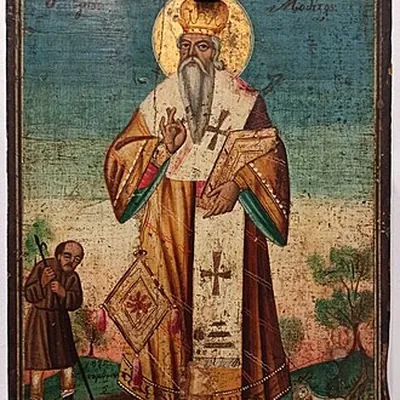
Saint Michael the Synkellos (Syncellus) was a monk and writer of the 9th century, born in Jerusalem in 761 and died in Constantinople on January 4, 846. A monk of the laura of Saint Sabbas, then "synkellos," that is, assistant, of the patriarch of Jerusalem, he was imprisoned several times by the Byzantine emperors for defending the veneration of holy images. His feast day is December 18 in the Catholic calendar.
Who was Saint Michael the Synkellos?
Michael is one of the witnesses of the iconoclast crisis, the long conflict that tore the Byzantine Empire apart in the 8th and 9th centuries: emperors wanted to ban icons, while many monks defended their veneration, grounded in the mystery of the Incarnation. Born in Palestine under Muslim rule, speaking Arabic and Greek, he lived between Jerusalem and Constantinople. His main source is an anonymous Life, written shortly after his death by a monk of the Chora monastery in Constantinople, who had questioned his relatives and disciples. Historians have shown that some claims in this text do not fit the known chronology, so it must be read with care. The overall testimony remains solid: that of a faithful monk who preferred prison to compromise.
A monk of Jerusalem
Offered as a small child to the service of the Church of the Holy Sepulchre, Michael grew up in the shadow of Christ's tomb. As an adult, he entered the great laura of Saint Sabbas, one of the most famous monasteries of the Christian East, in the Judean desert. He was ordained a priest there in 798. In 800, two brothers, Theodore and Theophanes, entered the monastery and became his disciples; they would remain his companions on the road and in trial. Michael was also a man of learning: he translated from Arabic into Greek a letter from Bishop Theodore Abu Qurrah to the Armenians, setting out the faith of the Council of Chalcedon.
These were hard years for the Christians of Palestine. Monasteries suffered raids: in 796, twenty monks of Saint Sabbas were killed, and the violence increased after 809. In 811, Michael became synkellos of Patriarch Thomas I and moved, with his two disciples, to a monastery next to the Holy Sepulchre.
A mission that stopped at Constantinople
In 812 or 813, the patriarch sent him toward Constantinople, then Rome. His Life attributes several aims to the mission: to speak to the pope about the filioque, the addition to the Creed that had caused tension in Jerusalem between Greek and Latin monks; to ask for help for the Churches of Jerusalem; to support the cause of icons. Historians think this last point was added by the hagiographer, as iconoclasm had not yet been restored. Michael and his companions settled at the Chora monastery in Constantinople, which welcomed monks who had fled Palestine. They never went to Rome.
Confessor of the holy images
In 815, Emperor Leo V restored iconoclasm. Michael and his companions refused to accept it. They were locked in a prison of the palace, where attempts were made to make them give way, including offers of high church offices. They refused. They were separated: Theodore and Theophanes were sent to a fortress on the Black Sea, while Michael and the monk Job remained in prison until the death of Leo V, in 820. Freed by Michael II, they then lived in a monastery at Prusa, at the foot of the Bithynian Olympus, a great monastic center. There Michael gave a eulogy of Saint Dionysius the Areopagite.
Under Emperor Theophilos, persecution resumed with greater harshness. In 834, Michael and Job were imprisoned in Constantinople, in isolation. In 836, Theodore and Theophanes, held for a while in the same place, suffered a terrible torture: insulting verses were carved on their faces, which earned them the name "Graptoi," "the inscribed." Michael managed to send them a letter of consolation.
The triumph of Orthodoxy and death
On March 11, 843, Empress Theodora had the veneration of images restored: this is what the Eastern Church celebrates as the "Triumph of Orthodoxy." Michael was honored as a hero of the faith; his Life even claims that he was considered for the patriarchal see. He became synkellos of the new patriarch, Methodios, and hegumen of the Chora monastery. He wrote a poem to celebrate this triumph. He died on January 4, 846.
Michael left several works: the eulogy of Dionysius the Areopagite, a profession of faith, liturgical canons, a treatise on Greek syntax and his translation of the letter of Theodore Abu Qurrah. Other texts are attributed to him without certainty, such as a Life of Saint John Damascene, because another Michael, also a synkellos, lived in the same century.

Devotion
Michael the Synkellos is venerated by the Orthodox Church and listed on December 18 in the Catholic calendar of saints; depending on the calendar, his memory is also placed on December 17. The Church often remembers him together with his disciples, Saints Theodore and Theophanes Graptoi, who shared his trials.
What can we learn from Saint Michael the Synkellos?
Michael spent long years of his life in prison for a reason that may seem distant: the right to venerate icons. But behind this question lay faith in the Incarnation: because God became man, he can be depicted. Michael refused the honors offered to him as the price of his silence. He was also a father to his disciples, supporting them even in their sufferings. You can pray to him for persecuted Christians, for prisoners of conscience, for the Christians of the East and for unity between Catholics and Orthodox.
To pray with him, see the prayer to Saint Michael the Synkellos and the novena to Saint Michael the Synkellos.
Where to pray to Saint Michael the Synkellos
- Monastery of Saint Sabbas (Judean desert): the laura where he became a monk and priest.
- Jerusalem: the Basilica of the Holy Sepulchre, to whose service he was entrusted as a child.
- Istanbul: the former church of the Chora monastery, of which he was hegumen, now a mosque.
Discover also
- Saint Theodore the Studite, another great defender of icons in the same period.
- Saint John Damascene, monk of Palestine and Doctor of the Church, theologian of images.
- Saint Sabbas the Sanctified, founder of the laura where Michael became a monk.
- Saint Stephen the Sabaite, a monk of Saint Sabbas in the same period.