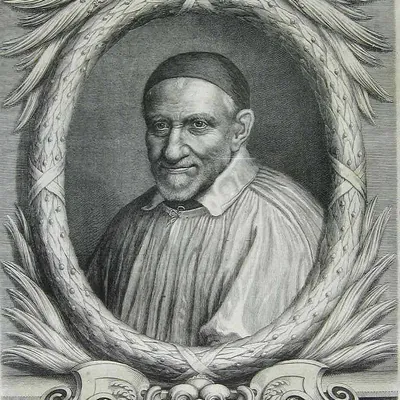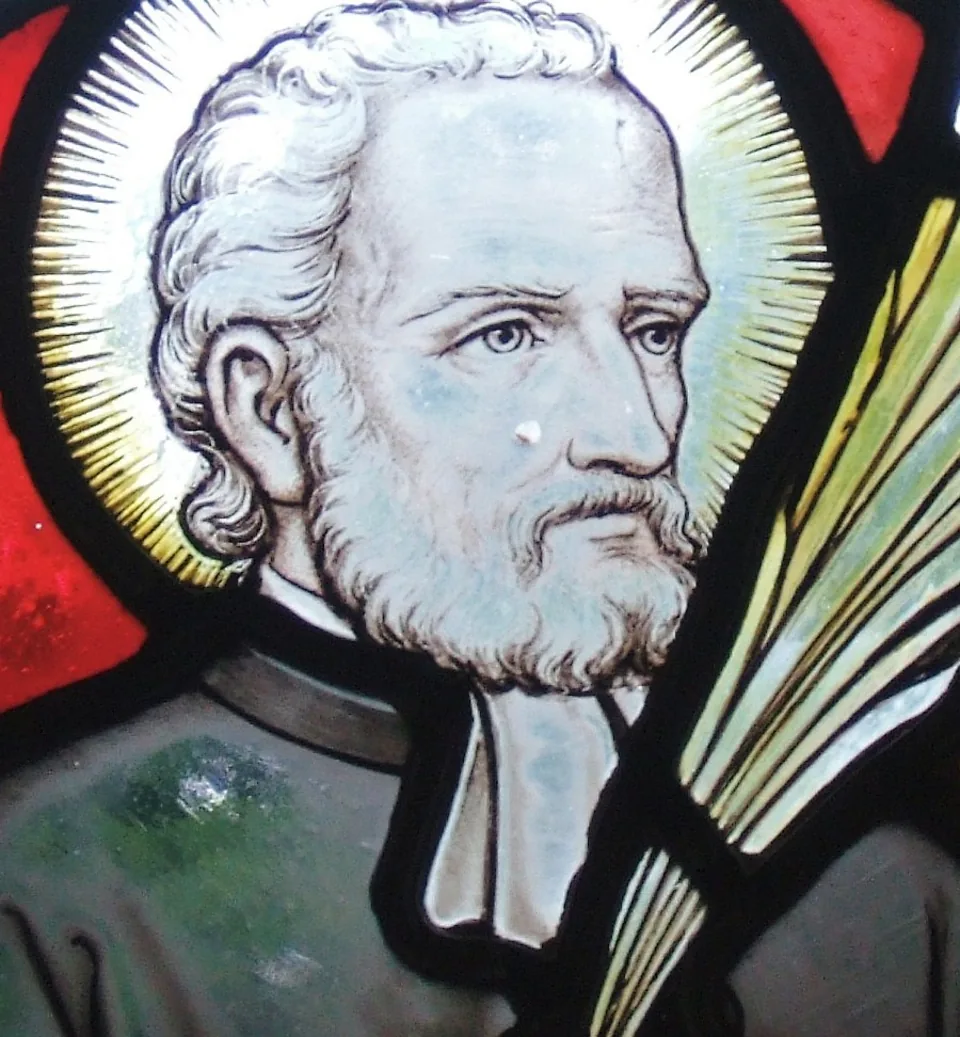
Saint John Kemble was an English Catholic priest born around 1599 in Herefordshire, on the border with Wales. For more than fifty years, he secretly served the Catholics of his region. Arrested at nearly eighty during the panic set off by the so-called "Popish Plot," he was executed at Hereford on August 22, 1679. He is one of the Forty Martyrs of England and Wales. His feast day is August 22.
Who was Saint John Kemble?
John Kemble was born around 1599 into a Catholic family in Herefordshire, a rural county in the west of England. At that time, Catholic practice was forbidden, and it was impossible to train for the priesthood in the kingdom. The young man therefore went to the English College at Douai, in Flanders, where he was ordained a priest on February 23, 1625. That same year, he returned to England.
So began a very long life as a missionary priest. For more than half a century, John Kemble traveled the countryside of Herefordshire and neighboring Monmouthshire, celebrating Mass in homes, baptizing, hearing confessions and visiting the sick. He lived at Pembridge Castle, near Welsh Newton, with members of his family. The Catholic people of the area knew him and protected him.

Half a century of hidden faithfulness
We often picture martyrs as heroes of a few days. John Kemble was first of all a priest for a whole lifetime. Fifty-three years of ministry, carried out quietly, following the rhythm of the seasons and the villages: Masses at dawn in a barn or a bedroom, confessions whispered, children baptized, the dying accompanied. The laws punished with death any priest ordained abroad, but in this rural region Catholics were still numerous, and the old priest was able to carry on his work for a long time.
The so-called Popish Plot
In 1678, an adventurer, Titus Oates, invented out of thin air a Catholic plot to assassinate King Charles II. Panic spread across England. Dozens of Catholics were arrested, tried and executed, among them many priests.
John Kemble, almost eighty, was arrested at Pembridge Castle. He could have fled, but he refused, saying that at his age he had not long to live and that it was better to die for his faith. He was taken to Hereford, then to London, where he was questioned about the plot. No evidence tied him to this invented affair. The only charge that stood was that he was a Catholic priest, which under the law was treason. He was sent back to Hereford to be executed.
The last pipe
On August 22, 1679, before being led to the place of execution, John Kemble asked to finish his prayers. According to an old account, he then shared a last pipe and a drink with the under-sheriff, calmly and good-humoredly. For a long time in the area, a last pipe smoked among friends was called a "Kemble pipe." At the place of execution, he declared that he was dying only for his Catholic faith, and not for any plot. He was hanged, then disemboweled and quartered, as traitors were treated at the time.
Veneration and iconography
His body was buried in the churchyard at Welsh Newton, near Pembridge Castle, where his grave has remained a place of pilgrimage. A relic, his hand, is venerated at Hereford. John Kemble was beatified in 1929 by Pius XI, then canonized by Paul VI on October 25, 1970, with the Forty Martyrs of England and Wales. His feast day is August 22. He is shown as an old priest with white hair, sometimes with a pipe or the rope of his execution.

What can we learn from Saint John Kemble?
John Kemble was faithful long before he was a martyr. His holiness was built over time, through humble, everyday service. Facing death, he kept his peace, and even his sense of humor. He can accompany the elderly, priests worn down by the years, and all who must persevere in a long-term commitment.
To pray with him, see the prayer to Saint John Kemble and the novena to Saint John Kemble.
Where to pray to Saint John Kemble
- Welsh Newton (Herefordshire, England): his grave, in the churchyard, a place of pilgrimage.
- Hereford: the city of his martyrdom, where a relic of his hand is venerated.
- Douai (France): the city where he was trained and ordained a priest.
Discover also
- Saint John Southworth, another priest trained at Douai and martyred.
- Saint Edmund Campion, Jesuit martyred at Tyburn.
- Saint Nicholas Owen, who hid priests in Catholic homes.
- Saint John Ogilvie, martyr priest in Scotland.