Saint Jacques Berthieu was a French Jesuit priest, born in Auvergne in 1838 and martyred in Madagascar on June 8, 1896. The son of farmers from the Cantal, he was first a diocesan priest of Saint-Flour before entering the Society of Jesus at thirty-five in order to go on mission. For some twenty years he served the Christian communities of Réunion, the island of Sainte-Marie and the main island of Madagascar, until he was killed by insurgents for refusing to deny his faith. Beatified in 1965 and canonized by Pope Benedict XVI in 2012, he is celebrated on June 8.
Who was Saint Jacques Berthieu?
Jacques Berthieu belongs to the great generation of nineteenth-century French missionaries. Nothing seemed to destine him for adventure: he was first a solid, patient country priest, trained in the seminaries of his diocese. But the desire for faraway missions grew in him. As a Jesuit, he spent the rest of his life serving the people of Madagascar, learning their language, opening schools and mission stations, and standing by Christians through the wars and unrest that shook the island at the end of the century.
His death during the Menalamba uprising of 1896 made him the first martyr of Madagascar recognized by the Church. He did not die as a political hero: several times he was offered his life if he would give up his religion, and he refused. He is a witness of simple faithfulness, to the very end, to the people entrusted to him.

A priest from Auvergne
Jacques Berthieu was born into a family of austere and devout farmers in the Cantal, in the mountains of central France. He studied at the minor seminary of Pleaux, then at the major seminary of Saint-Flour. Ordained in 1864, he was sent as curate to Roannes-Saint-Mary. The parish priest, who had been expecting someone else, received him coldly; the young priest did not complain and adapted. This patience in difficult situations remained a mark of his character.
For nine years he ministered in his diocese. But he wanted to go to mission lands. Just as his bishop was thinking of making him a parish priest, he asked to join the Jesuits. He was thirty-five when he began his novitiate in Pau in 1873. At the Jesuit house of studies in Vals, near Le Puy, he deepened his devotion to the Sacred Heart under the influence of Father Henri Ramière, a great promoter of the Apostleship of Prayer.
Missionary in the Indian Ocean
In 1875 Father Berthieu left for Réunion, then for the island of Sainte-Marie, today Nosy Boraha, off the east coast of Madagascar. There he learned Malagasy and worked with two other Jesuits and the Sisters of Saint Joseph of Cluny. In 1880 French laws expelling religious congregations struck the Jesuits in all French territories, including Sainte-Marie. The missionary then moved to the main island, which was still an independent kingdom.
He worked first among the Betsileo, south of Antananarivo. During the first Franco-Malagasy war, the French were gathered at Toamasina (Tamatave), and he volunteered as a military chaplain. Afterward he was sent to the Ambositra district, which he led from 1886 to 1891. He multiplied mission stations and cared especially about education: for him, school was the path to dignity and faith. He wrote in a letter:
"The mission is progressing, although in many places the fruits are still only a hope and in others barely visible. But what does it matter to us, as long as we are good sowers: God will make things grow in his own time."
In the heart of the storm
In 1891 he was appointed north of Antananarivo. Tensions ran high there: rivalry between Protestants and Catholics and growing colonial pressure from France. The war of 1894-1895 led to a French protectorate over the island, then to the abolition of the monarchy. The missionary had to withdraw to Réunion for a time before returning.
In 1896 the Menalamba ("red shawls") uprising broke out, directed both against French rule and against Christianity, seen as a threat to traditional religion. Father Berthieu tried to bring his Christians to safety. He refused to abandon them and led a column of villagers falling back toward Antananarivo. Poorly protected, the column was attacked on June 7, 1896. The priest was captured, stripped and beaten.

The martyrdom of Ambiatibe
The insurgents led him toward their chief's camp. For the wounded priest, the march was a true Way of the Cross. Several times he was offered the chance to abandon his religion and become one of their leaders. He answered: "I cannot consent to that; I would rather die." Passing the church of Ambohitra, where he had often celebrated Mass, he asked to go in; his guards refused. He knelt at the door and prayed the Our Father aloud.
On the evening of June 8, near the village of Ambiatibe, about sixty kilometers (forty miles) from Antananarivo, he was shot. As he still seemed to be looking at them, on his knees, he was finished off with a club. His body was thrown into the Mananara River and never found. Later, Father Théophile Weber, missionary of that district, heard the confession of one of his killers and baptized two others.
The first saint of Madagascar
Paul VI beatified him on October 17, 1965, during a session of the Second Vatican Council. Benedict XVI canonized him on October 21, 2012, World Mission Sunday, together with six other saints. In Madagascar his memory is alive: pilgrimages and Stations of the Cross are held on the places of his passion, between Ambohitra and Ambiatibe. In Auvergne, his home parish of Polminhac also keeps his memory.
The Jesuits in France commemorate him on June 8; according to Jesuit sources, the other provinces of the Society of Jesus remember him on February 4.
Why is Saint Jacques Berthieu a model for missionaries?
Saint Jacques Berthieu has no official patronage, but he is a natural intercessor for missionaries, for the Church in Madagascar, for late vocations and for persecuted Christians. A man rooted in his native soil, he became a man of the world. He loved his Auvergne deeply, yet he wrote that he loved "far more still these uncultivated fields of Madagascar." He reminds us that mission is not first of all visible success, but seed entrusted to God. He is also the model of the shepherd who does not flee when danger comes and stays with his flock.
Symbols and how to recognize Saint Jacques Berthieu in art
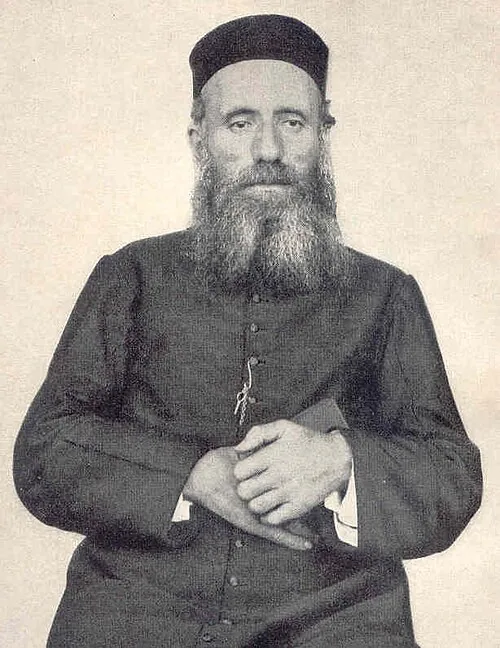
Saint Jacques Berthieu is known mainly from nineteenth-century photographs: a priest in a cassock. Images made for his beatification and canonization often show him in Madagascar among the people he served, sometimes kneeling in prayer, recalling the Our Father he prayed at the door of the church of Ambohitra.

Where to pray to Saint Jacques Berthieu
- Ambiatibe (Madagascar): the memorial on the site of his martyrdom, a place of pilgrimage.
- Ambohitra (Madagascar): the church at whose door he prayed the Our Father during his last march.
- Polminhac (Cantal, France): his home village and its parish church.
- Saint-Flour (Cantal, France): the town of his major seminary and home diocese.
To pray with him, see the prayer to Saint Jacques Berthieu and the novena to Saint Jacques Berthieu, from May 30 to June 7.
Discover also
- Saint Ignatius of Loyola, founder of the Society of Jesus.
- Saint Francis Xavier, patron of the missions and model for Jesuit missionaries.
- Saint Théophane Vénard, another French missionary martyred in the nineteenth century, in Vietnam.
- Saint John de Brébeuf, Jesuit martyr in New France.
- Saint Peter Chanel, French missionary martyred in Oceania.