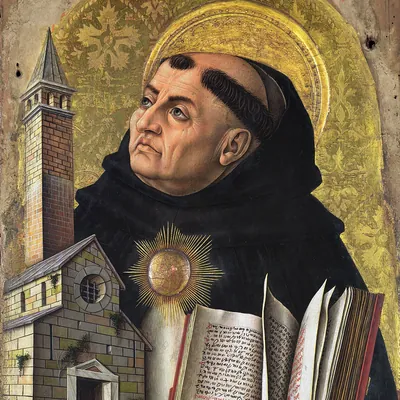
Saint Douceline of Digne was a Provençal mystic of the 13th century. Born in Digne around 1214, a sister of the Franciscan Hugh of Digne, she founded near Hyères, around 1240, the first community of Beguines in Provence: women consecrated to God and to the service of the poor without living in an enclosed convent. She died in Marseille on September 1, 1274. Patron of the people of Hyères, her feast day is September 1.
Who was Saint Douceline?
Douceline belongs to the great movement of spiritual renewal that, in the 13th century, led many lay people, men and women, to live the Gospel radically, in the wake of Saint Francis of Assisi. The Beguines, numerous in northern Europe, led a life of prayer, chastity and charity, often in community, but without taking the solemn vows of enclosed nuns. Douceline brought this way of life to Provence. We know her through an exceptional text: her Life, written in Occitan toward the end of the 13th century by one of her disciples, Philippine de Porcelet, from Arles. It is an account full of admiration, which stresses her penances and ecstasies, written by a woman who had known her.
Douceline was never formally canonized. She is honored as a saint through an ancient local cult, which the diocese of Fréjus-Toulon still keeps alive in Hyères.

A youth spent serving the poor
Douceline was born in Digne, in Upper Provence, into a well-off and deeply Christian family. She spent her youth in Barjols. Her mother taught her early on to give: the girl distributed alms, visited the poor and cared for the sick. Her brother Hugh joined the Franciscans, where he became a renowned preacher. Douceline looked for her own path. After a time with the Poor Clares, she understood that she was not called to the cloister, but to a consecrated life in the midst of the world, entirely given to God and to the poorest. She then took the simple habit of the Beguines.
Founder of the Beguines of Provence
Around 1240, ladies of Provence came to join her. A community formed at Roubaud, near Hyères: it was the first Beguine house in Provence. These women promised to live in chastity and devoted themselves to prayer and to the care of the poor and the sick, without following a religious rule in the strict sense. Douceline added poverty and obedience for herself. Advised by her brother Hugh, she gave her companions a Franciscan spirituality of detachment and love for the poor Christ. The Beguines later also settled in Marseille, where Douceline spent the end of her life.
A life of penance and ecstasy
Her Life describes very harsh penances, which can be admired without being imitated: she wore a pigskin against her body and a belt of thorns that wounded her flesh. She spent long hours in prayer and often fell into ecstasy, so much that those around her saw her as absent from the world. The account tells that the mere song of a bird could be enough to carry her away to God, because all beauty spoke to her of her Creator. These traits show a soul on fire with the love of God, in a century that loved extreme spiritual gestures.
Her death and cult
Douceline died in Marseille on September 1, 1274. The bishop of Orange delivered her funeral eulogy. The following year, her body was laid in the Franciscan church of Marseille, next to her brother's. Her tomb became a place of prayer and many miracles were reported there. Saint Louis of Toulouse, the Franciscan bishop who died in 1297, even asked in his will to be buried near Hugh and Douceline. The Franciscan convent where she rested no longer exists today.
Her memory has remained alive in Hyères, of which she is the patron. A church of Sainte-Douceline was opened there in 1970.

What can we learn from Saint Douceline?
Douceline opened a new path: a life entirely consecrated to God, without enclosure, in the service of the poor. She reminds us that there are many ways of giving one's life to Christ, and that holiness can flourish outside the usual forms. She also shows that a spiritual friendship, like the one that united her with her brother Hugh, can bear much fruit. You can pray to her for consecrated women, for those who serve the poor and for people searching for their vocation.
To pray with her, see the prayer to Saint Douceline and the novena to Saint Douceline.
Where to pray to Saint Douceline
- Hyères (Var): the church of Sainte-Douceline, in the town of which she is patron.
- Marseille (Bouches-du-Rhône): the city where she died and where she was long venerated by the Franciscans.
- Digne-les-Bains and Barjols (Provence): the places of her birth and youth.
Discover also
- Saint Francis of Assisi, whose spirituality inspired her community.
- Saint Clare of Assisi, whose daughters she knew in Digne.
- Saint Louis of Toulouse, who wished to be buried near her and her brother.
- Saint Roseline of Villeneuve, another great mystic of medieval Provence.