Saint Casimir was a prince of the Jagiellonian dynasty, son of King Casimir IV of Poland, who died at the age of twenty-five in 1484. Heir presumptive to the throne, he refused a royal marriage and lived a life of prayer, charity and penance in the midst of the court. Canonized in the early 16th century, he is the patron saint of Lithuania, a secondary patron of Poland and, since 1948, patron of young people. His feast day is March 4, the anniversary of his death.
Who was Saint Casimir?
Casimir, Kazimierz in Polish and Kazimieras in Lithuanian, was born on October 3, 1458, at Wawel Castle in Kraków. He was the second son of King Casimir IV Jagiellon, ruler of Poland and Grand Duke of Lithuania, and of Elizabeth of Habsburg. Through his two grandfathers, Władysław II Jagiełło and Emperor Albert II, he was connected to the greatest families of Central Europe.
From the age of nine, he was entrusted to two remarkable teachers: the priest and historian Jan Długosz, and the Italian humanist Filippo Buonaccorsi, known as Callimachus. He received an education that was both Christian and princely, designed to make him a statesman.

The prince who gave up a crown
In 1471, Hungarian lords unhappy with their king, Matthias Corvinus, offered the crown of Hungary to the young Casimir. The prince accepted, hoping to defend Christendom against the Ottomans, as his uncle Władysław III had done before being killed at the Battle of Varna in 1444. But the expedition came to nothing: the expected support failed to appear, and Pope Sixtus IV did not back the venture. Casimir returned to Poland. His father, displeased, kept him apart for a time in a fortress. This failure seems to have matured the young man, who returned to his studies and deepened his inner life.
When his older brother Vladislaus became King of Bohemia, Casimir became heir presumptive to the Polish throne and was associated with the government. When the king resided in Lithuania, from 1479, Casimir administered the kingdom in his name, and his contemporaries praised his wisdom and his sense of justice.
A life of prayer at court
His father wanted him to marry Kunigunde, daughter of Emperor Frederick III. Casimir refused and chose to remain unmarried. Tradition says that he spent long hours in adoration before the Blessed Sacrament, that he was sometimes found at night praying at the locked doors of churches, and that he had a deep filial love for the Virgin Mary.
The Marian hymn Omni die dic Mariae ("Daily, daily, sing to Mary") is associated with him: he is said to have asked that a copy be placed in his coffin. The text is older and not his own, but it has remained known as the "Hymn of Saint Casimir." He was also very close to the poor, the sick and the oppressed, and lived simply, with fasts that weakened his health.
Suffering from a lung disease, probably tuberculosis, he died on March 4, 1484, at Grodno, during a stay in Lithuania. He was buried in Vilnius Cathedral.
The patron saint of Lithuania
Miracles were reported at his tomb, and his reputation for holiness grew. He was canonized in 1522; sources attribute the decision to Pope Adrian VI, sometimes to his predecessor Leo X. In 1613 he was declared patron of Lithuania. In the 17th century, a magnificent Baroque chapel was built for his relics in Vilnius Cathedral.
His cult survived the trials of Lithuanian history. In 1953, under the Soviet regime, the cathedral was turned into a picture gallery and his relics were moved to the Church of Saints Peter and Paul. On March 4, 1989, as Lithuania was about to regain its independence, they were solemnly returned to the cathedral, now given back to worship. Every year around March 4, the great Saint Casimir's Fair, the Kaziuko mugė, still fills the streets of Vilnius.
Why is Saint Casimir the patron saint of Lithuania and of young people?
Casimir lived and died as a prince of the Polish-Lithuanian union, and he is buried in Vilnius, which explains why Lithuania took him as its patron and Poland honors him too. Lithuanian and Polish immigrants brought his name with them, and many parishes in the United States and elsewhere are dedicated to him. Pius XII made him patron of young people because he made his life choices young: he put God first, kept his heart free and served the weak, without running away from his responsibilities. He is also prayed to for those who hold power and for purity of heart.
To pray with him, see the prayer to Saint Casimir and the novena to Saint Casimir, from February 23 to March 3.
Symbols and how to recognize Saint Casimir in art
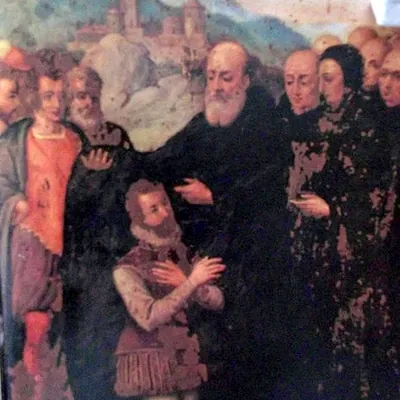
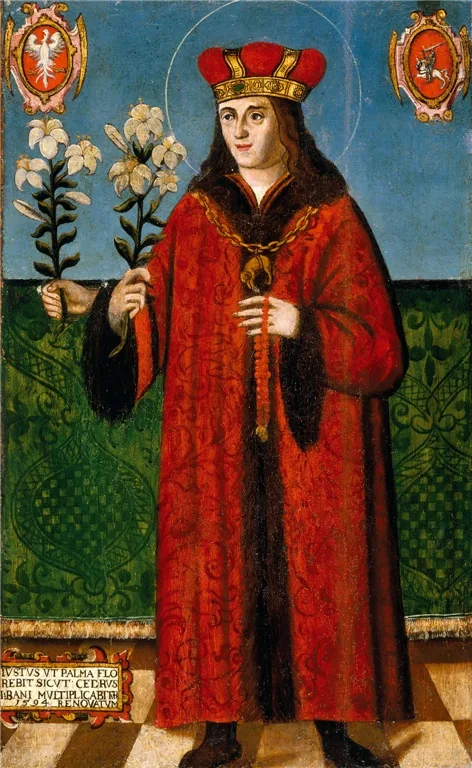
Saint Casimir is shown as a young prince in a royal mantle, often wearing a crown or with a crown nearby, and holding a lily, the sign of purity. The old painting venerated on the altar of his chapel in Vilnius is famous for a popular legend: the prince appears to have three hands, because, it is said, the painter could not erase a hand he wanted to correct.

Where to pray to Saint Casimir
- Vilnius (Lithuania): the Saint Casimir Chapel in the cathedral, where his relics rest in a silver sarcophagus.
- Vilnius: the Church of Saints Peter and Paul, which sheltered his relics from 1953 to 1989.
- Kraków (Poland): Wawel Castle, where he was born.
- Hrodna (Belarus): the city where he died.
Discover also
- Saint Hedwig of Poland, the queen whose marriage to Władysław Jagiełło united Poland and Lithuania.
- Saint Stanislaus Kostka, another young Polish saint, patron of young people.
- Saint Aloysius Gonzaga, a prince's son who also gave up his inheritance.
- Saint Adalbert of Prague, one of the patron saints of Poland.
- Saint Faustina Kowalska, who lived in Vilnius, where the image of Divine Mercy was painted.