Saint Benildus (Brother Bénilde), born Pierre Romançon, was a nineteenth-century Brother of the Christian Schools from the Auvergne region of France. A schoolteacher for more than forty years, he directed the school of Saugues, in the Haute-Loire, for twenty-one years and died there on August 13, 1862. Pope Pius XII said of him that he "did ordinary things in an extraordinary way." Canonized by Pope Paul VI in 1967 and patron saint of accordion players, he is celebrated on August 13.
Who was Saint Benildus?
Brother Benildus is a saint of everyday life. He founded no order, wrote no books and performed no great public deeds. He taught class every day to the children of farmers, taught the catechism, visited the sick and prayed. But he did it with such a living faith that the little town of Saugues was transformed, and hundreds of vocations were born around him. He is one of the saints of the institute founded by Saint John Baptist de La Salle, and Lasallian schools around the world, including the De La Salle-College of Saint Benilde in Manila, carry his name.

A child of the Limagne
Pierre Romançon was born in a village of the Limagne plain, north of Clermont-Ferrand. His parents were farmers. His childhood was marked by grief: he lost his mother, two sisters and a brother. A bright pupil of the Brothers of the Christian Schools in Riom, he was drawn to their life. At fourteen he was already working as an assistant teacher, but his request to join the Brothers was turned down: he was too young. He persisted, and the following year, in 1820, he entered the novitiate in Clermont-Ferrand, despite his father's opposition. He received the name Brother Bénilde, after a ninth-century martyr of Córdoba.
Twenty years of teaching on the move
For about twenty years, Brother Benildus taught in various elementary schools of the institute, in central France: Riom, Moulins, Limoges, Aurillac, Clermont-Ferrand, Billom. For a time he was also in charge of the community's kitchen and vegetable garden. Everywhere, people noticed his seriousness, his regularity and his piety. Without knowing it, he was preparing for the work of his life.
The school of Saugues
In 1841, the town council of Saugues, a small town in the Margeride highlands, asked for Brothers to open a school, paid for by public subscription. Brother Benildus was sent to found and direct it. He stayed there until his death. The beginnings were hard: three Brothers for about three hundred pupils, a harsh climate, misunderstandings and criticism. He held firm.
He was known as demanding but fair. He supported the weakest pupils, organized evening classes for adults, and his school became a center of the town's life. He taught music to the children by playing the diatonic accordion, the instrument he also used to accompany singing in church and the community's recreation. This is why accordion players chose him as their patron.

Catechist and sower of vocations
For Brother Benildus, the school was above all a place to learn to know and love God. He prepared children for First Communion with special care, visited the sick and prayed with them. He used to say: "Without faith, ours would be a hard job. But with faith, everything changes." His example shone so brightly that at his death some two hundred Brothers and about fifteen priests had come from the canton of Saugues alone.
Death and canonization
Worn out by work, Brother Benildus died on August 13, 1862. On the very day of his funeral, a paralyzed person regained the use of their legs as the procession passed. His tomb became a place of pilgrimage. Declared Venerable in 1928, he was beatified in 1948 and canonized by Pope Paul VI on October 29, 1967. His relics are kept in a reliquary shrine in the Church of Saint Médard in Saugues.
Why is Saint Benildus the patron saint of accordion players?
Benildus used the diatonic accordion to teach music to his pupils and to accompany hymns in church and the recreation of his community. In 1990 he was chosen as the patron of accordion players. He is also invoked by teachers, educators and catechists, and as an intercessor for vocations, because he reminds us that holiness lies in faithfulness to small things: preparing a lesson, correcting notebooks, encouraging a struggling pupil, praying for those we teach.
Symbols and how to recognize Saint Benildus in art
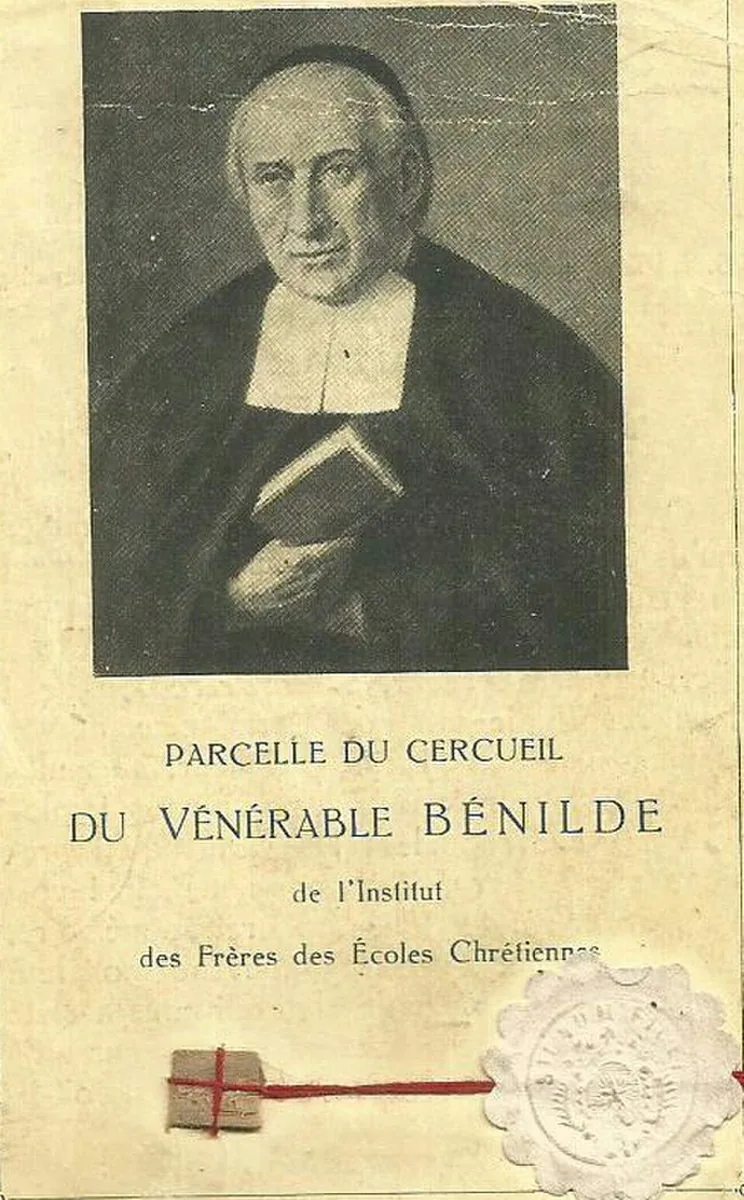
He is shown in the black habit of the Brothers of the Christian Schools, with the white bands (the rabat) at the collar. Statues often show him surrounded by children he is teaching.
To pray with him, see the prayer to Saint Benildus or the novena to Saint Benildus, prayed from August 5 to his feast on August 13.
Where to pray to Saint Benildus
- Saugues (Haute-Loire, France): the Church of Saint Médard, which keeps the shrine of his relics.
- Thuret (Puy-de-Dôme): the church where he was baptized, now dedicated to Saint Bénilde, and his birthplace, with a pilgrimage every summer.
- Riom (Puy-de-Dôme): the town where he was a pupil of the Brothers.
- The Lasallian schools that bear his name, in France and around the world.
Discover also
- Saint John Baptist de La Salle, founder of the Brothers of the Christian Schools.
- Saint Marcellin Champagnat, founder of the Marist Brothers, another educator of rural France.
- Saint John Vianney, his contemporary, the Curé of Ars.
- Saint John Francis Regis, apostle of the Velay and the Vivarais.
- Saint John Bosco, educator of youth in the nineteenth century.