Saint Ariald, or Arialdo, was an 11th-century deacon of Milan, born around 1010 in Carimate, in Lombardy. With Landolfo Cotta, he led the Pataria, a movement of clergy and laypeople who called for priests who were poor, chaste and free from the love of money. This struggle cost him his life: he was murdered on June 27, 1066, on an island in Lake Maggiore, and Pope Alexander II proclaimed him a martyr the very next year. His feast day is June 27.
Who was Saint Ariald?
Ariald was born around 1010 in Carimate, north of Milan, into a noble family. He received an advanced education, studying among other places at Laon, in France, and was then ordained a deacon of the Church of Milan. He then saw the state of the clergy in his city: Church offices bought for money, the sin known as simony, and many priests living with women outside of marriage. Ariald decided to oppose this by preaching. We know his life through a biography devoted to him and to his companion Erlembald, attributed to Andrew, a monk of Vallombrosa, who had been his disciple.
The Pataria, a cry for a poor Church
In the middle of the 11th century, the Church of Milan was rich and powerful. Many of its offices were sold, and some of the clergy lived like lords. Ariald preached against these abuses with great force. He drew clerics and a crowd of laypeople, craftsmen and ordinary folk, along with him. Their opponents scornfully nicknamed them "Patarines," from a word in the Milanese dialect that is thought to mean rags: and so the movement took the name Pataria.
Ariald and his friends asked that priests live in chastity and that Church offices no longer be bought. In this they joined the great reform movement led by the papacy at the same time, which would reach its height with Saint Gregory VII. Rome supported the Pataria: Saint Peter Damian came to Milan as papal legate to restore discipline there.
A dangerous struggle
Ariald's struggle was a violent one, and he paid the price. Archbishop Guido da Velate, whom he accused of many failings, excommunicated him. Pope Alexander II canceled the sanction and encouraged him to continue. Ariald in turn obtained the excommunication of the archbishop. The city was divided. A first attempt on his life, with a poisoned sword, had already been made. In 1066 a riot broke out in Milan, and Ariald was seriously wounded.
He had to flee. His enemies found him and took him to a small island in Lake Maggiore, near Arona. There, two clerics tortured him, mutilated him and killed him, on June 27, 1066. They weighed his body down and threw it into the lake to make every trace disappear.
Devotion and art
Ten months later, Ariald's body was found in the lake, described as well preserved. It was brought back to Milan with honor and displayed in the Basilica of Sant'Ambrogio from Ascension to Pentecost, then buried in the church of San Celso. In 1067 Pope Alexander II proclaimed him a martyr. His companion Erlembald, who died a few years later in the same struggles, is also honored as a saint, and the Life of Saint Ariald tells their stories together.
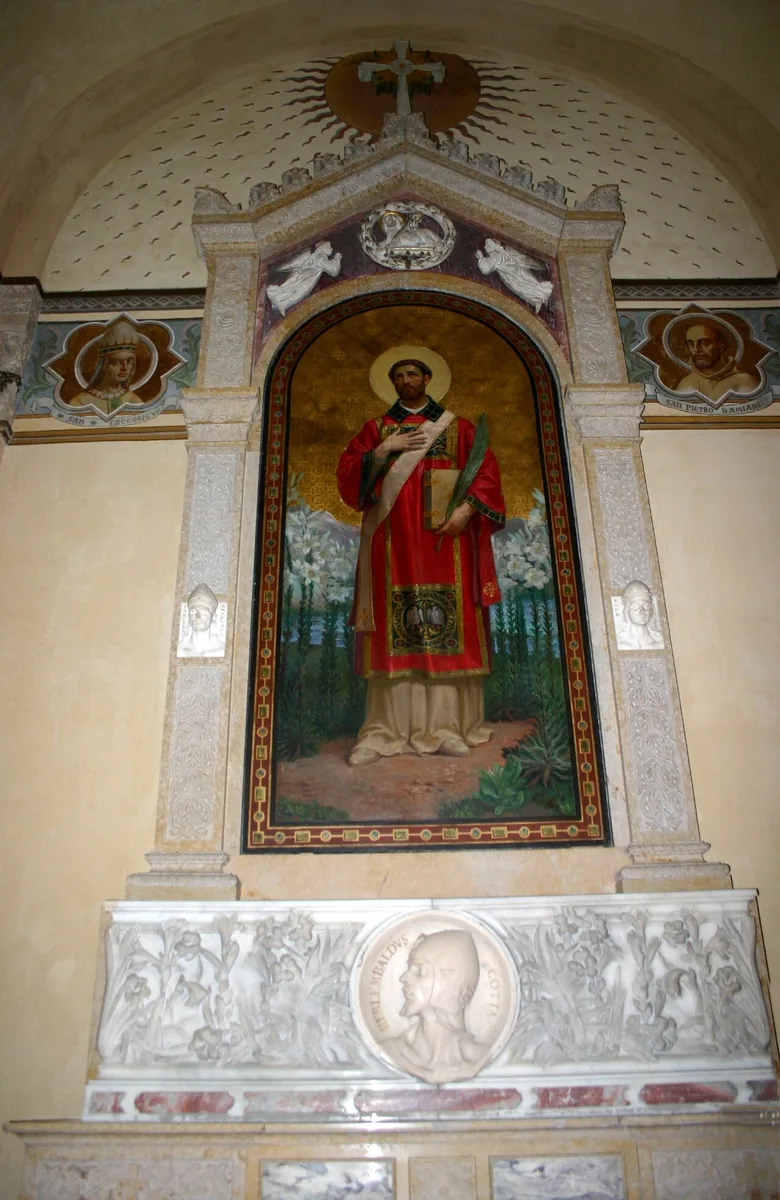
Ariald appears in the Roman Martyrology on June 27. He is shown wearing a deacon's dalmatic, with the palm of martyrdom. The church of San Calimero in Milan has a depiction of his martyrdom.
What can we learn from Saint Ariald?
Ariald loved the Church so much that he wanted to see it pure. He did not leave the Church to criticize it from outside: he served it as a deacon, in communion with the pope, and gave his life for its reform. His struggle was sometimes harsh, in an age of great violence. He reminds us that the holiness of priests and the honesty of the Church concern all the baptized. We can pray to him for priests, for truth in the Church and for those who expose abuses at the cost of their own peace.
To pray with him, you can use the prayer to Saint Ariald or the novena to Saint Ariald.
Where to pray to Saint Ariald
- Milan (Italy): the church of San Calimero, where his martyrdom is depicted, and the Basilica of Sant'Ambrogio, where his body was displayed in 1067.
- Carimate (province of Como): his home village.
- Lake Maggiore: the shores at Arona and Angera, near the place of his martyrdom.
Discover also
- Saint Peter Damian, papal legate in Milan at the time of the Pataria.
- Saint Gregory VII, the pope of the great reform that Ariald heralded.
- Saint Ambrose of Milan, the great bishop of his city, in whose basilica his body was displayed.
- Saint Bertrand of Comminges, a reforming bishop of the same period in the Pyrenees.